
Lighting Installation in the USA
Our technicians begin every Lighting Installation by tracing the branch circuit back to the panel and confirming available amperage. They measure conductor size and check for shared neutrals that could create overloads once new fixtures draw power. Voltage drop calculations determine whether existing wiring supports added LED drivers or incandescent loads without dimming.
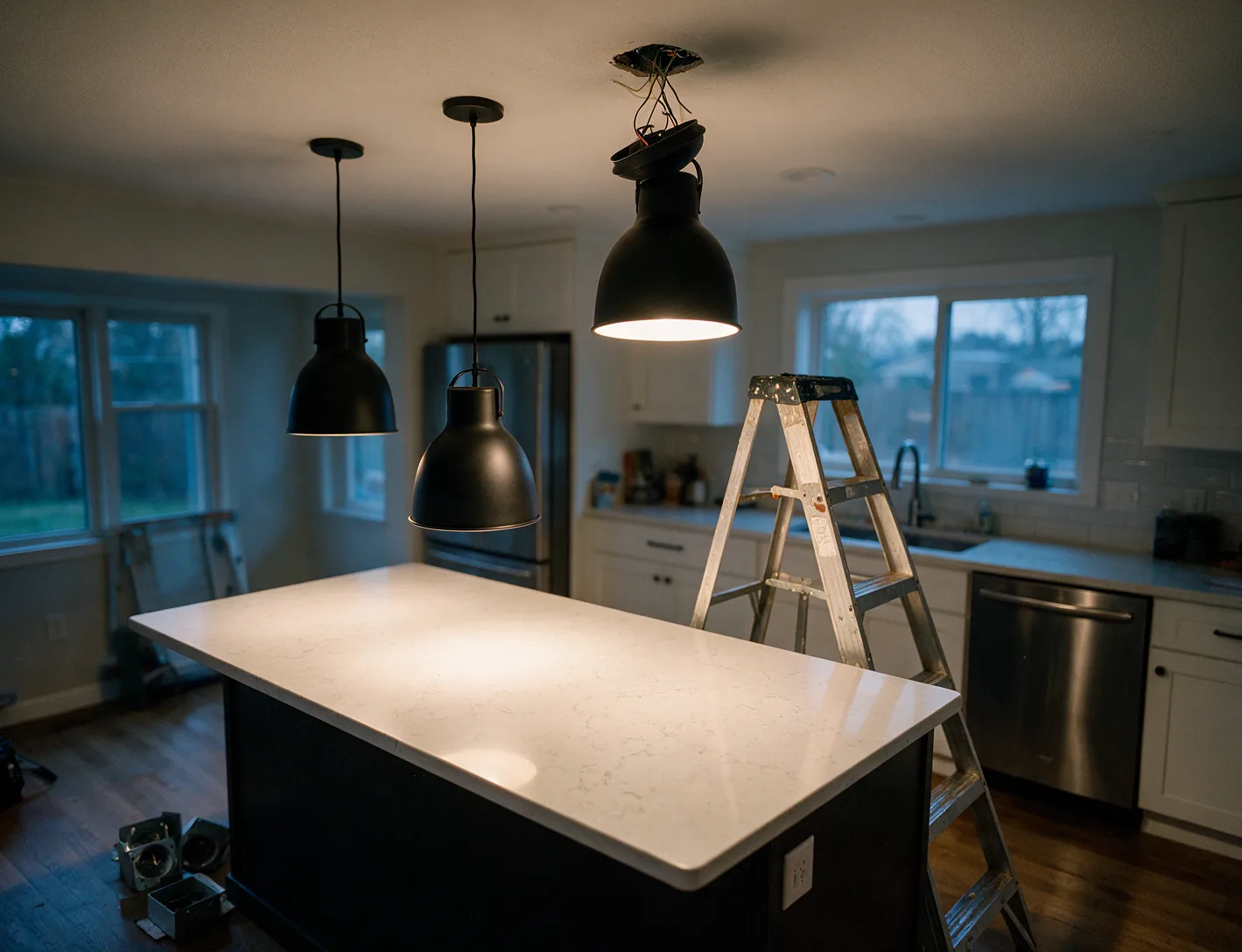
Next they map fixture locations to avoid joist conflicts and plan box fill so each junction meets code volume requirements. Technicians install appropriate support hardware rated for fixture weight and route cable or conduit along shortest protected paths. Grounding conductors are bonded at each metal box before any device is connected. Ikon Electrical Services takes lighting installation calls from homeowners across the USA.
Indicators That Lighting Circuits Need Attention
- Lights dim when additional fixtures turn on.
- Warm junction boxes signal undersized conductors.
- Flicker occurs on one switch but not others.
- Burn marks appear around ceiling box edges.
- New fixtures trip the breaker immediately after install.
Pre-Installation Circuit Verification
Technicians first de-energize the target circuit at the panel and lock it out. They use a non-contact voltage tester at every outlet and switch on that line to confirm zero potential. A clamp meter then records the existing load in amps so remaining capacity can be calculated against fixture wattage.
They also inspect wire insulation color and gauge markings inside each box. Aluminum conductors receive special connectors rated for the transition to copper pigtails. Any shared neutral that serves both lighting and receptacles is separated to prevent neutral current from exceeding conductor rating.
Fixture Mounting and Conductor Routing
Ceiling boxes are replaced with fan-rated or fixture-rated boxes when weight exceeds twenty-five pounds. Technicians drill access holes only through load-bearing members and protect cable with bushings at each penetration. They maintain at least six inches of spare conductor inside every box for future splices.
For surface-mounted track or linear fixtures, they secure channel with toggle bolts into solid backing rather than drywall alone. Low-voltage LED drivers mount outside the fixture envelope so heat does not affect driver life. All splices use twist-on connectors listed for the conductor count and size present.
Grounding and Polarity Testing
Every new lighting circuit receives a continuous equipment grounding conductor back to the panel. Technicians bond the ground to the metal box with a green screw before any fixture is hung. They verify polarity at the switch loop so the ungrounded conductor always lands on the brass terminal.
After connections are made they perform a megger test between conductors and ground to confirm insulation integrity above one megohm. Final energization occurs only after a visual inspection of torque on all terminals and a load test that records steady-state current draw.
Homeowner Steps Before Technician Arrival
Locate the breaker that controls the area and turn it off. Test nearby switches and outlets with a lamp or meter to confirm the correct circuit is isolated. Note any existing dimmers or three-way switches and leave them in place for the technicians to evaluate.
Clear furniture and fragile items from the work zone and provide access to the attic or crawl space if cable runs will cross those areas. Identify any fixtures that must remain operational during the project so alternate temporary lighting can be planned.
Lighting Installation questions
What type of cable is used for new lighting circuits?
Technicians select 14 AWG or 12 AWG NM cable sized for the breaker and total connected load. They staple the cable within twelve inches of each box and every four and one-half feet along framing members.
How do you decide between recessed and surface fixtures?
Ceiling construction and insulation depth determine whether IC-rated recessed cans can be installed without disturbing vapor barriers. Surface fixtures are chosen when joist spacing prevents proper can placement or when existing wiring lacks slack for new boxes.
Can existing switch loops be reused?
Only if the white conductor is re-identified as an ungrounded supply and a separate equipment ground is added. Technicians replace two-wire loops with three-wire cable whenever the box is opened so grounded conductors reach each fixture.
What happens to old fixture wiring?
Technicians remove abandoned conductors back to the last active splice point and cap them with listed connectors. They label any remaining wires at the panel so future tracing remains clear.
Schedule Lighting Installation
Contact Ikon Electrical Services to arrange Lighting Installation that matches your circuit capacity and fixture requirements.